
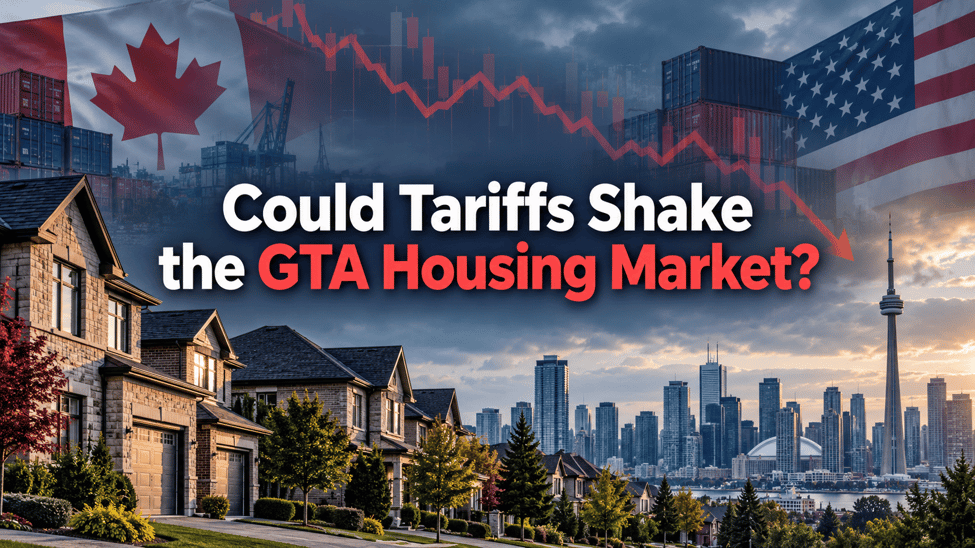
Could Canada-U.S. trade uncertainty become a housing problem in the Greater Toronto Area? The answer may have less to do with tariffs themselves and much more to do with what happens to Ontario jobs.
That is the connection GTA homeowners, buyers, sellers and investors should be watching. A tariff does not put a For Sale sign on someone’s lawn, but a lost paycheque can. And even before jobs disappear, uncertainty about employment can change how people behave in the housing market.
With trade negotiations suspended, tariffs already announced and another potential increase affecting Canadian vehicles and automotive parts hanging over 2027, the bigger question is how these pressures could filter through Ontario’s economy and into the GTA housing market.
Watch Full Video
Why GTA Housing Market Trade Uncertainty Matters
Ontario is particularly exposed to changes in manufacturing, especially the automotive industry. Canada’s auto industry produces roughly 1.2 million vehicles a year and indirectly supports approximately 427,000 jobs.
That reach goes well beyond assembly plants. It includes automakers such as Toyota, Honda, GM and Ford, along with parts manufacturers, steel, transportation, warehousing, suppliers and thousands of other jobs and businesses connected to the industry.
A significant amount of that economic activity is concentrated in Ontario.
This does not mean 427,000 people are about to lose their jobs. It also does not mean the proposed 50% U.S. automotive tariff, currently scheduled for January 1, 2027, will necessarily happen as announced. A deal could still occur before then, and auto industry executives have expressed doubt that the tariff will necessarily take effect as proposed.
But the uncertainty itself matters.
Housing Can React Before Layoffs Happen
Imagine working in manufacturing and hearing that your employer is reviewing its Canadian operations. Nobody has announced layoffs. Your paycheque is still arriving. But suddenly, your income feels a little less secure.
Are you going to upgrade to the bigger house? Buy an investment condo? Take on another $800,000 mortgage?
Probably not. You may simply wait.
That is one of the most underestimated forces in real estate: uncertainty. Buyers do not necessarily have to lose their jobs before becoming cautious. They only have to believe their income might be less secure.
When that happens, buyers can negotiate harder, stop competing or refuse to stretch financially. Instead of multiple offers, a seller may receive one aggressive offer well below asking. More homes come onto the market, inventory begins building and sellers find themselves competing for fewer confident buyers.
That is one way an economic problem can turn into a real estate problem.
Toronto Mortgage Delinquencies Are Another Signal to Watch
The GTA is entering this period of trade uncertainty with some households already facing financial pressure.
Nationally, mortgage delinquencies remain low. This is not being described as a national mortgage crisis. However, Toronto’s 90-day mortgage delinquency rate rose from approximately 0.2% to 0.29%.
That may look like a small absolute increase, but it represents a 45% year-over-year increase. The important point is not that Toronto homeowners are suddenly defaulting in huge numbers. They are not. It is the direction of the trend that deserves attention.
The research discussed in the video also identifies a weaker GTA labour market as one of the pressures limiting households’ ability to manage rising mortgage payments.
Now combine several pressures: some home prices have declined, some owners have less equity than they did at the market peak, some borrowers have faced higher mortgage payments, and some investors are dealing with higher carrying costs and softer rents.
If meaningful employment losses were added to that mix, household vulnerability could become more serious.
How Job Losses Could Create Forced Inventory
Financial pressure usually does not arrive all at once. It can build gradually.
A household may first cut spending. Then credit card balances grow. A line of credit gets used. Savings are depleted. The homeowner may refinance, extend an amortization or sell an investment property.
Eventually, if income disappears and the financial cushion runs out, some households may need to sell their homes. That is when financial stress can become forced inventory.
This is why employment is such an important indicator. If trade pressure begins producing meaningful Ontario job losses while financially vulnerable GTA borrowers are already under pressure, the combination matters much more than any single statistic on its own.
Why 2027 Mortgage Renewals Deserve Attention
There is no magical date when the Canadian housing market suddenly crashes. But 2027 brings together two developments worth watching.
First is January 1, when the proposed 50% U.S. automotive tariff is currently scheduled to begin if it goes ahead.
Second, by the second half of 2027, nearly all mortgage holders facing the large payment increases associated with pandemic-era borrowing are expected to have renewed.
There is another important number in the analysis discussed in the video: at current home prices, approximately 9% of Toronto-area borrowers renewing in 2027 could be unable to refinance under the assumptions used in the analysis. If Toronto-area home prices were to fall another 10%, that estimate rises to approximately 12%.
That does not mean 9% of Toronto homeowners will default, lose their homes or be forced to sell. It refers specifically to the estimated share of Toronto-area homeowners renewing in 2027 who could be unable to refinance under those assumptions. Those borrowers may have other options.
The concern is the potential combination: difficult refinancing, falling home equity and rising unemployment. That would represent a convergence of financial pressures, not a prediction that a housing crash is inevitable.
Could Lower Interest Rates Change the Picture?
There is another possible side to the story. If the economy weakens enough, the Bank of Canada could lower interest rates to help stimulate economic activity.
The research discussed in the video found that when interest rates fall, house resales can respond relatively quickly, while new construction responds with a delay. Demand also tends to respond more strongly than supply.
But that creates a difficult balancing act if tariffs are also pushing prices higher. A weakening economy could provide a reason to lower rates, while higher inflation could limit how much help lower rates can provide.
For housing, that means the outcome is unlikely to depend on one variable alone.
What GTA Buyers, Sellers and Investors Should Be Watching
Rather than trying to predict exactly how the trade dispute will unfold, there are several signals worth following.
- Ontario employment: especially jobs in industries exposed to tariffs. Meaningful job losses would move the trade dispute from headlines into household finances.
- Housing inventory: rising listings combined with weaker employment could leave more sellers competing while buyers become increasingly cautious.
- Mortgage delinquencies: the absolute rate remains low, but a continuing upward trend alongside rising unemployment would signal increasing household vulnerability.
- Housing construction: if construction continues weakening and fewer projects proceed, that could potentially create a future supply problem.
There may also be opportunities in an uncertain market. Buyers can sometimes gain negotiating power, with sellers accepting substantially less than their original asking prices.
For move-up buyers, a declining market is not automatically negative if the more expensive property falls by more dollars than the home being sold. For sellers, waiting is not automatically the safest strategy if additional inventory is coming onto the market in their neighbourhood.
Investors should also be watching carrying costs, rents, inventory and future housing supply because the GTA does not move as one single market.
The Bigger Housing Risk Is Employment
Could Canada’s trade fight create another housing shock? It could. But the bigger housing risk is not simply that tariffs make products more expensive. The more important issue is what happens if trade uncertainty begins meaningfully hurting employment.
Housing decisions are made around paycheques, mortgage payments, confidence and expectations about the next year. That is why Ontario employment, GTA inventory, mortgage stress and the approaching 2027 renewal period are all worth watching together.
The goal is not to predict who wins or loses a trade dispute. It is to understand how changing economic conditions could affect your housing decisions before circumstances make those decisions for you.
Have questions about what trade uncertainty and changing GTA market conditions could mean for your real estate plans?