February 2026 GTA Real Estate Market Report | Sales, Prices & Trends
February 2026 GTA Real Estate Market Report: A Different Kind of Spring Market
Published March 2026 | Greater Toronto Area Housing Market
According to the Toronto Regional Real Estate Board February 2026 Market Watch report, home sales across the Greater Toronto Area slowed compared to last year while more listings came onto the market. This shift is giving buyers more options and negotiating power as the market continues to rebalance.
Is the GTA Housing Market Finally Recovering… ?
If you’ve spoken to anyone about real estate lately, you’ve probably heard the same question over and over again.
"Is the market finally coming back… or is it still dropping?"
It’s the question homeowners whisper at dinner parties. It’s the question buyers type into Google late at night. And it’s the question that keeps popping up in our inbox.
Because the newest numbers from the Greater Toronto Area housing market just came out.
And they reveal something that caught a lot of people off guard.
Sales are down again. Prices are slipping again. Homes are sitting longer.
And one entire segment of the market has quietly erasedsix years of price growth.
But here’s the twist…
Even with all of that happening…
the market might be quietly setting up thenext housing cycle.
And if you own a home in the GTA—or you're thinking about buying somewhere in Ontario—you need to understand what’s really happening before the spring market unfolds.
Because one of the biggest mistakes people make during housing corrections is assuming the bottom already happened… when the data is starting to suggest it may not have.
The Broken Floor Nobody Was Expecting
Two months into 2026, Toronto’s housing market was supposed to be stabilizing.
That was the story, anyway.
Many analysts believed the correction had already bottomed sometime last year. The assumption was that by early 2026, the worst would be behind us, and the market would slowly begin to recover.
Then February showed up and politely kicked that theory down the stairs.
Because instead of bouncing… the market appears to have broken below the floor.
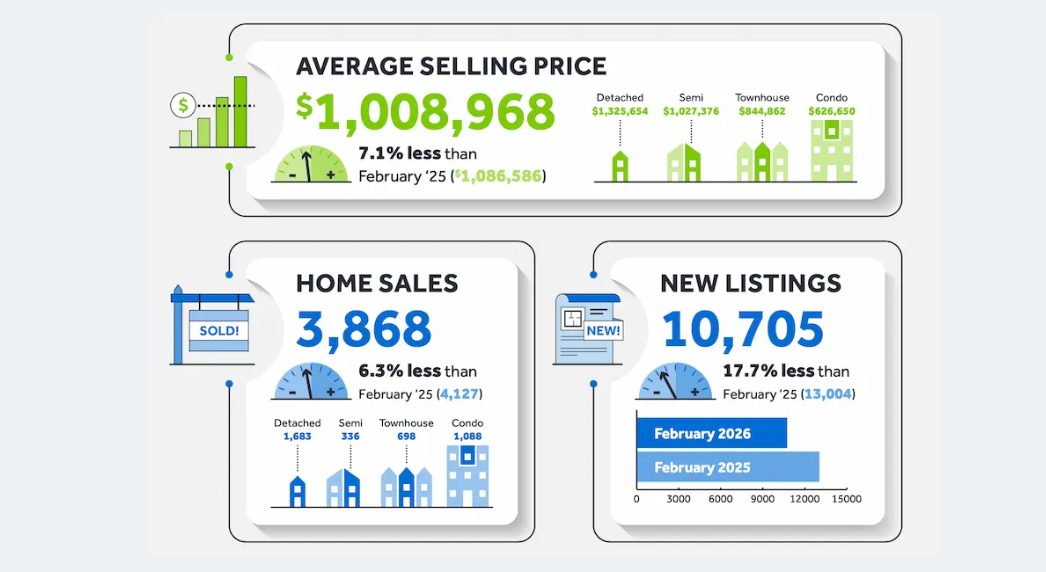
The Toronto Regional Real Estate Board reported 3,868 home sales in February.
That’s 6.3 percent fewer salesthan February last year.
At first glance, that might not sound especially dramatic. Six percent doesn’t exactly scream chaos. It’s not the kind of number that makes people spill their coffee.
But context matters.
And this is where the story becomes far more important.
Last year was already one of the slowest housing markets in decades. So if 2026 is now tracking below those already depressed levels, it tells us something the headlines alone may miss.
The correction may not be finished yet.
What makes this downturn unusual is that it doesn’t feel like a crash.
It feels more like a slow leak.
The market isn’t collapsing in one dramatic moment. It’s grinding lower, month by month, with all the emotional excitement of watching paint dry in a waiting room.
And oddly enough, slow corrections are often harder on buyers than fast ones.
Because slow markets create uncertainty.
Buyers begin waiting for better prices. Waiting for lower interest rates. Waiting for the economy to feel safer. Waiting for affordability to improve. And sometimes… waiting because nobody wants to catch a falling knife with a mortgage attached to it.
But housing markets rarely offer certainty.
In fact, they usually move before people feel comfortable.
And that’s exactly why this phase of the cycle feels so confusing.
Homes Are Sitting Longer—and Buyers Know It
Another signal that the market is still adjusting is how long homes are taking to sell.
In February, the average days on market rose to 36 days.
That’s 33 percent longer than last year.
Now on its own, that’s a notable change.
But when you include homes that were listed, failed to sell, then came back wearing a new price and pretending nothing happened, the average jumps to 54 days.
That’s nearly two full months on the market.
And that creates a completely different environment from what buyers and sellers experienced just a few years ago.
Today, buyers have leverage again.
They can negotiate. They can ask questions. They can include conditions. They can walk away.
And many of them are doing exactly that.
This shift in power is one of the clearest signals that the market is still correcting—not recovering in any meaningful broad-based way just yet.
CONDO SELLING PRICE
The Condo Market Just Lost Six Years
Here’s where the story gets even more interesting.
The biggest reset in Toronto housing is not happening in detached homes.
It’s happening in condos.
And this part of the market has gone through a much deeper repricing than many people expected.
The median condo price has fallen back to around $590,000.
That’s roughly where condo prices were inFebruary 2020.
Pause on that for a second.
That means the condo segment has effectively erased about six years of price growth.
Six years. Gone.
That’s not a small adjustment. That’s a full-circle reset.
Meanwhile, freehold homes have not corrected nearly as dramatically. Yes, they’ve faced pressure too. But the entry-level condo market has taken the heavier hit.
And historically, this kind of rapid repricing in the condo segment is significant.
It tells us just how stretched affordability had become—and how sensitive that segment is to borrowing costs, investor sentiment, and weaker buyer demand.
In other words, condos didn’t just cool off.
They got a reality check.
The Inventory Paradox
Now here’s where things get a little strange.
Because despite weaker demand, supply is not behaving the way many people expected.
Normally, February is when listings begin to surge. Sellers gear up for the spring market. Inventory rises. New choices flood the market.
But this year, the opposite happened.
New listings fell 17.7 percent year-over-year, dropping to just over 10,700 homes.
Active inventory also declined slightly.
That creates what many analysts are calling an inventory paradox.
Because falling inventory usually points to stronger demand.
But that’s not what we’re seeing.
Demand isn’t roaring back.
Instead, sellers are pulling back.
Many homeowners are choosing not to list at all. They’re waiting for prices to stabilize. Waiting for rates to improve. Waiting for a more confident economy. Waiting for someone else to go first.
And when both buyers and sellers decide to wait, the market stalls.
Sales drop. Volume falls. Momentum disappears.
That’s exactly what the GTA market looks like right now.
Not broken beyond repair. Not booming either.
Just stuck in a tense little staring contest.
Why This Stalemate Won’t Last Forever
Housing stalemates always feel like they’ll last forever—until they don’t.
Eventually, something forces the market to move.
It could be lower interest rates. It could be improving economic confidence. It could be easing inflation. Or it could be global factors that spill into the local housing story.
And this is where the conversation gets bigger than just Toronto real estate.
Because very few housing discussions right now are paying enough attention to energy markets and trade tensions.
When oil prices rise, inflation often follows. And when inflation becomes sticky, central banks have a harder time cutting rates quickly.
That keeps borrowing costs higher for longer.
And higher borrowing costs continue to weigh on housing demand.
At the same time, tariffs and trade tensions—especially involving construction materials like steel and aluminum—can increase building costs.
That makes new housing more expensive to build.
When construction costs rise, builders slow projects. Some developments get delayed. Others stop making sense financially.
And that matters because Canada already has a housing supply problem.
So the market is being pulled in two directions at once.
Short-term demand is weak. Long-term supply remains tight.
And when those two forces collide, the result can be a very choppy and unpredictable housing cycle.
Not Every Part of the GTA Is Moving the Same Way
One of the biggest mistakes people make is talking about the GTA as though it’s one market.
It isn’t.
Different regions are behaving very differently right now.
And one area showing more resilience is Durham Region.
Markets like Whitby and Oshawa are outperforming many other parts of the GTA.
Homes are selling faster there. Sale-to-list price ratios remain relatively strong. And the reason is simple:
affordability.
As borrowing costs stay elevated, buyers are moving farther from Toronto’s core in search of homes that still fit within their budgets.
We’re also seeing stronger movement in freehold homes under $700,000.
These properties are still attracting attention, and in some cases, still receiving competing offers.
That tells us something important.
When affordability tightens, demand doesn’t vanish.
It shifts.
Buyers become more selective. More practical. More focused on value over glamour.
Meanwhile, downtown condos are feeling the opposite pressure.
More supply. More investor selling. Slower demand.
Which helps explain why the condo correction has been much more dramatic than what we’ve seen in many freehold segments.
The Missing Middle Problem Nobody Can Ignore
Now let’s talk about one of the most overlooked structural issues in the GTA housing market:the missing middle.
Right now, the market feels split between two extremes.
On one side, you have condos. On the other, detached homes.
But the housing in between—townhomes, duplexes, triplexes, laneway suites, and smaller multi-unit buildings—has been dramatically underbuilt.
And that gap is doing real damage to affordability and mobility.
Because when there are too few stepping-stone homes, buyers struggle to move up the ladder.
They stay in condos longer. Family-sized options stay scarce. That middle segment stays expensive. And the entire chain of transactions slows down.
In other words, when the housing ladder breaks, everybody feels it.
Buyers can’t move up. Sellers can’t move on. And the number of transactions falls.
Industry groups are pushing governments to accelerate missing-middle construction, and that’s an important conversation.
But even if policies improved tomorrow, the results would take years.
Approvals take time. Planning takes time. Construction takes time. And in real estate, “soon” can sometimes mean “after everyone has already changed their hairstyle twice.”
That means 2026 will likely remain a year of repricing and recalibration—not a year where this problem suddenly gets solved.
So… Is the Market Recovering or Still Falling?
That’s the big question.
And the honest answer is this:
The GTA housing market looks like it is still correcting, but it may also be laying the groundwork for the next recovery phase.
Those two things can be true at the same time.
Right now, prices are still adjusting. Sales remain historically weak. Homes are taking longer to sell. Buyer confidence is cautious. Seller confidence is shaky. And the spring market hasn’t yet delivered the clear rebound many people were hoping for.
But turning points in real estate rarely feel obvious while they’re happening.
The shift usually begins quietly.
First, inventory tightens. Then prices stabilize. Then sales start to rise. Then confidence comes back. And suddenly people say, “Wow, that moved fast.”
That’s how housing cycles work.
They spend a long time looking sleepy… and then they wake up all at once.
What Smart Buyers and Homeowners Should Be Watching Now
If you’re a homeowner, this is not the moment to panic.
But it is the moment to pay attention.
If you’re a buyer, this may be one of the most important windows in the cycle—not because conditions are perfect, but because uncertainty is creating opportunity for those who understand the market clearly.
And if you’re waiting for the all-clear signal, just remember:
by the time everyone agrees the market is safe again, the best opportunities are often already gone.
Right now, there are thousands of buyers sitting on the sidelines.
Watching. Saving. Waiting.
Waiting for lower interest rates. Waiting for stable prices. Waiting for the economy to feel clearer.
And when those signals finally align, the next cycle may begin faster than many expect.
That’s why understanding this phase matters so much.
Because the market isn’t just telling us what’s happening now.
It’s quietly hinting at what could happen next.
Final Thoughts
The GTA housing market is not in full recovery mode yet.
But it’s also not a simple story of endless decline.
What we’re really seeing is a market in transition—still correcting in some segments, stabilizing in others, and quietly preparing for whatever comes next.
That’s what makes this moment so important.
Because markets like this create questions. They create hesitation. And they create opportunity for the people who know how to read between the lines.
So whether you’re wondering what your home is worth, debating whether 2026 is your year to buy, or trying to understand where the best opportunities may be hiding across the GTA, now is the time to start paying closer attention.
The next move in real estate rarely announces itself with fireworks.
Sometimes it begins quietly—while most people are still waiting for certainty.
And that’s exactly why this market deserves a closer look.
Want to talk about what this means for your situation? Reach out and let’s have a real conversation about where the market is heading, what opportunities may be opening up, and how to make smart decisions before the next phase of the cycle becomes obvious.
Because even in a slower market, opportunity still exists for the people who are informed, prepared, and ready to act.
And as always, there’s reason to stay optimistic—real estate moves in cycles, and every cycle brings a new beginning.