
Toronto and GTA home prices are still under pressure. So why are some economists and market watchers suddenly talking about the possibility of a bottom?
Because July gave us a housing market that looks almost contradictory. Prices are still lower. Buyers haven't come flooding back. Yet the market is beginning to tighten.
And the reason may have less to do with buyers — and much more to do with sellers.
Some homeowners are simply deciding they would rather wait than accept today's price.
When enough sellers make that decision, something important happens: the number of homes available to buyers starts shrinking.
That's what makes July's market so interesting. We may be seeing early signs of stabilization, but before anyone declares the correction officially over, we need to understand what's actually creating that stability.
Because a market supported by returning buyers is very different from a market supported by disappearing sellers.
🎥 Monthly Market Outlook Video
In this month's video, we look at the market from both sides: a seller who doesn't want to accept today's price and a buyer who has patiently waited for better conditions. They're looking at exactly the same housing market and seeing two very different things.
The seller sees disappointment. The buyer sees opportunity. And strangely enough, they're both right.
The Market Tightened — But Buyers Weren't the Reason
This may be the most important takeaway from July.
Sales across the GTA were almost unchanged compared with last summer. What changed dramatically was the number of properties coming onto the market.
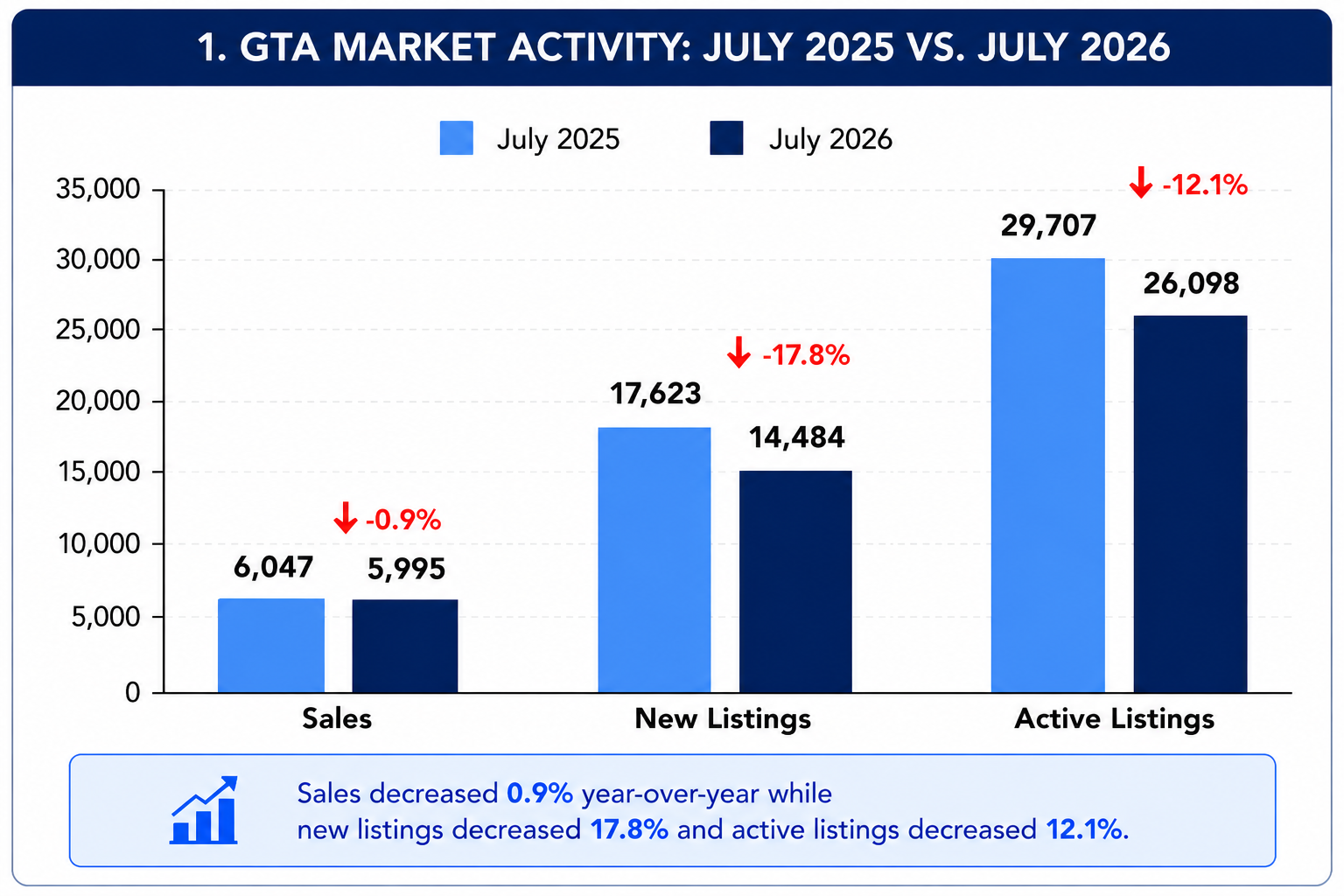
As the chart above shows, sales barely moved year-over-year, while new listings dropped sharply. The number of active listings was also considerably lower than it was last July.
That tells us something important.
The GTA didn't tighten because thousands of buyers suddenly rushed back. It tightened because fewer sellers showed up.
Think of it this way: If ten buyers are choosing between twenty homes, they have plenty of options. If those same ten buyers suddenly have only fifteen homes to choose from, the balance changes — even though not one additional buyer entered the market.
That's essentially what we're beginning to see.
And it could become one of the biggest factors influencing the GTA market over the next several months.
Where Did the Sellers Go?
When a listing disappears, it's easy to assume something went wrong. But many homeowners stepping away from today's market aren't necessarily distressed sellers.Quite the opposite.
Some have owned their homes for many years. They may have substantial equity, manageable mortgages or no urgent reason to move.If they don't like the offers they're receiving, they have an option that a motivated seller doesn't:
They can wait.
There's also a very human side to this.
A homeowner may remember what the house down the street sold for during a much stronger market. Maybe there were multiple offers. Maybe the final price was considerably higher than what buyers are willing to pay today.
Even if selling now would still produce a great financial result, today's price can feel disappointing compared with that old number. We've seen versions of that conversation many times.
Eventually, someone says, "I'll wait for the market to come back." The listing gets cancelled. The sign comes down. The seller waits. Do that across enough households and inventory starts disappearing.
That's how supply can tighten without buyer demand actually getting stronger.
Prices Are Still Lower — So Why Talk About a Bottom?
This is where July gets especially interesting. The average GTA selling price remained below where it was last summer.
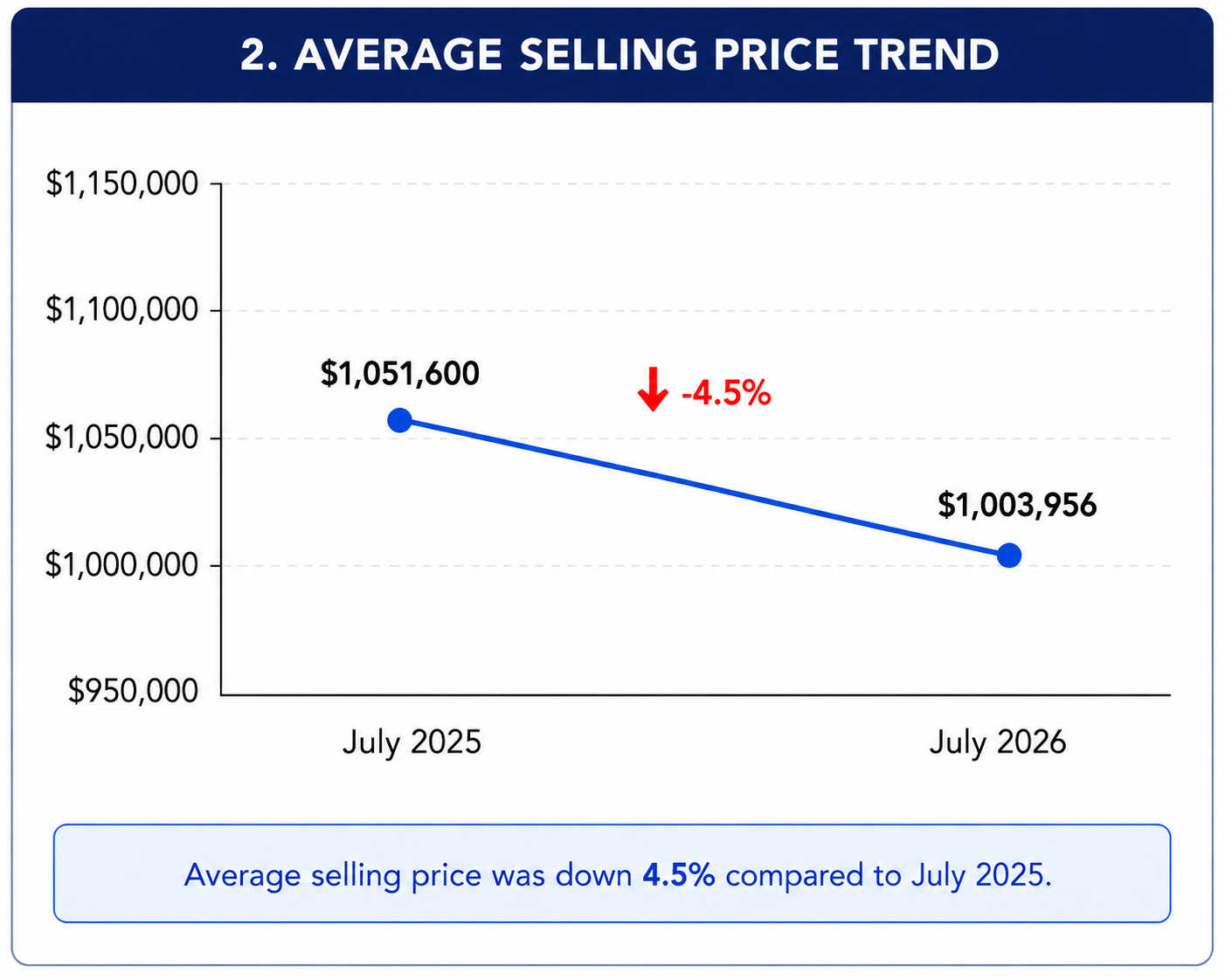
The chart makes the direction clear: the average selling price moved from roughly $1.05 million last July to just over $1 million this July.
So no, prices haven't suddenly started racing higher again. But there's a difference between prices falling quickly and prices beginning to find support. Some measures suggest the pace of deterioration is becoming less severe. At the same time, fewer listings are coming onto the market.
That's why we're starting to hear more discussion about whether the housing correction may be approaching a floor. But we'd be careful with that word.
There are signs the market may be finding a floor. There isn't enough evidence yet to say that floor is permanent.
And the reason comes back to one simple question: Is stability being created by stronger demand — or disappearing supply? Right now, it appears supply is playing a very important role.
What Happens When Those Sellers Come Back?
This could be the real test. The homeowners who decided not to sell haven't vanished forever. They're waiting.
Imagine prices begin to stabilize. Headlines become a little more optimistic. Buyers regain some confidence.
Suddenly, homeowners who pulled their properties off the market start thinking, "Maybe it's time to try again." They don't all need to list on the same Monday morning. 😄 They simply need to return faster than buyer demand grows.
If that happens, inventory rises again. Buyers get more selection. But sellers also get more competition.
And that's when we'll get a much better idea of how strong this supposed floor really is.
If returning buyers absorb those listings, that's encouraging. If listings increase faster than demand, prices could face renewed pressure. That's why July doesn't settle the argument.
July sets up the next test.
Buyers Still Have an Opportunity
For buyers, today's market offers something we haven't always had in the GTA: Time.
There are still properties where buyers can negotiate. Conditions can be possible. And prices remain below last year's levels. That's meaningful. But there's a trade-off developing. While prices may be more attractive, the selection of homes you actually want could become thinner if more sellers choose to wait.
That's why buyers shouldn't interpret talk of a "bottom" as a reason to panic.
Nothing about July suggests buyers need to run out and purchase the first property with a front door. This market isn't running away from buyers.At the same time, good properties can still move.
A well-maintained home on a desirable street, priced properly and presented beautifully, can attract serious attention. Take that same house and attach an overly ambitious price?
Buyers can suddenly become very busy people. 😄 That's today's market.
Not every property is weak. Not every property is strong. Knowing the difference is where opportunity lives.
Sellers Have an Opportunity Too — With One Big Condition
For sellers, declining inventory can be encouraging. Fewer listings mean less competition for buyer attention. But that doesn't mean buyers have suddenly stopped paying attention to value. They know when a property has been sitting. They can see comparable sales. And they're generally unwilling to rescue an unrealistic asking price.
That's why pricing and positioning matter so much in this market.
A seller who understands current value and presents the home properly may benefit from having fewer competing properties nearby. A seller pricing based on what the neighbour received during a completely different market may have a much harder time.
The opportunity is there.
But the market is demanding realism.
There Isn't One GTA Real Estate Market
There's another reason we're careful about big housing headlines. The GTA isn't one market. Different property types are moving differently.
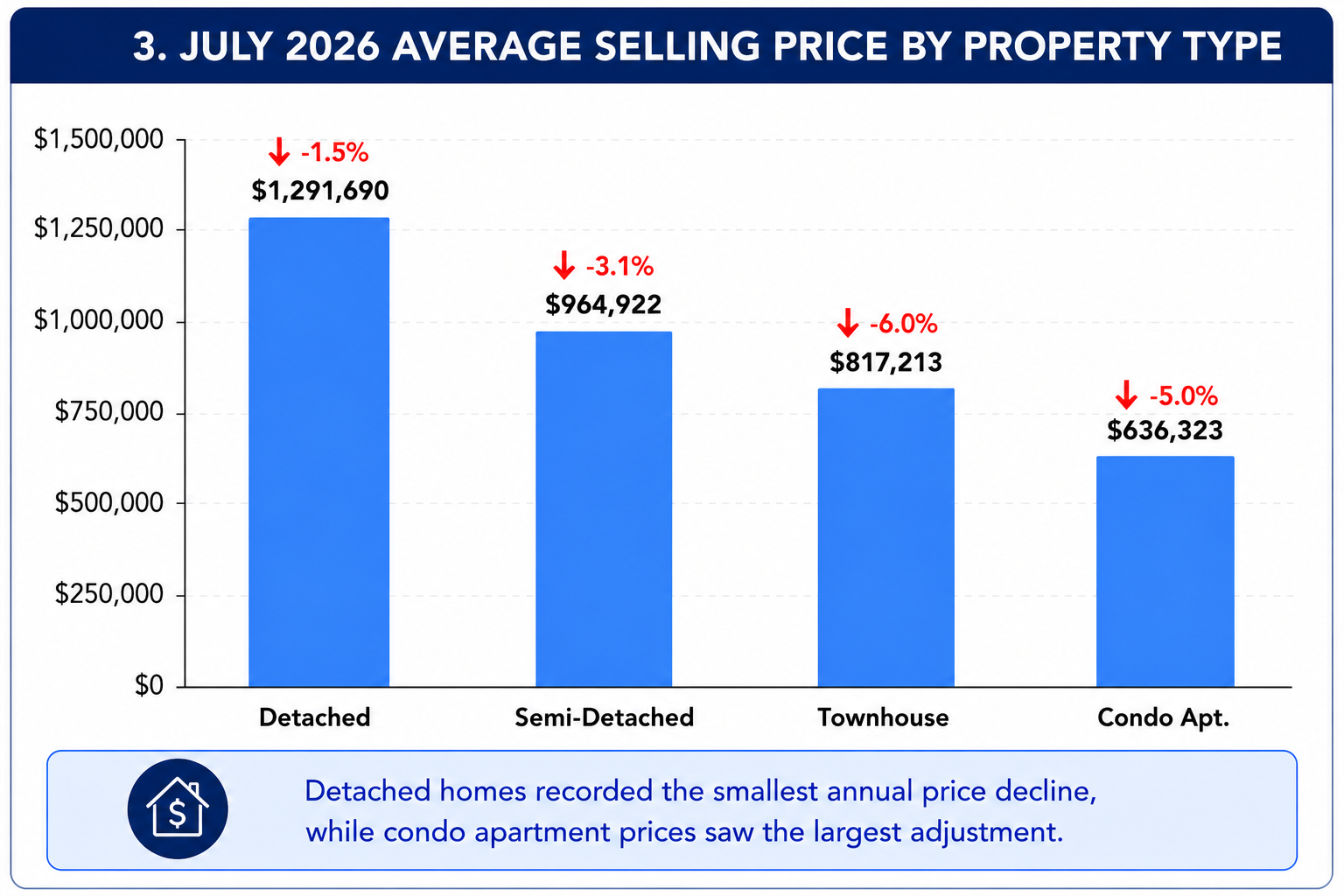
The chart above makes that clear.
Detached homes recorded the smallest year-over-year price decline among these major property types, while condo apartments experienced the largest adjustment.
That means someone looking at a detached home may be experiencing a very different market from someone shopping for a condo.
Then add geography.
Toronto isn't Mississauga. Mississauga isn't Vaughan. Vaughan isn't Durham. And even two neighbourhoods a few kilometres apart can have different inventory and completely different buyer demand.
Real estate is hyper-local.
That's why GTA-wide averages are useful for understanding direction, but they're not enough to make a personal real estate decision.
When you're making a six- or seven-figure move, what happened with homes like yours — or homes you actually want to buy — matters much more.
So… Has the GTA Hit Bottom?
Not enough evidence yet. There are reasons to be more optimistic than we were earlier in the correction. Price declines appear to be moderating on some measures. Inventory has tightened. Some economists are talking about stabilization. Those are worth paying attention to.
But a true recovery becomes easier to identify when buyers return more broadly, sales activity strengthens, confidence improves and price stability follows.
We haven't clearly seen that full sequence in the GTA yet. What we've seen instead is something more unusual:
Buyers are waiting for the right opportunity while sellers are waiting for better conditions.
Which group moves first could tell us a lot about what happens next.
What We're Watching Next 👀
Heading toward the fall market, supply will be one of the biggest things we're watching.
- Do sellers continue to hold back?
- Do buyers become more confident?
- And if conditions stabilize, how quickly do those sidelined sellers decide to return?
If buyers return first while inventory remains tight, the market could become more competitive.