
If you're comparing Maple and Woodbridge, you're not comparing two similar communities at different price points. You're comparing two completely different buying decisions that happen to sit within the same city. One of them is right for you. The other probably isn't — and we'll tell you which is which.
We've transacted extensively in both communities for over 20 years. Here's the honest side-by-side.
The Fundamental Difference Nobody Talks About
Woodbridge buyers feel something when they drive through. There's a pull — the Italian bakeries on Woodbridge Avenue, the sense that families have been here for generations, the streetscapes that actually have character. Buying in Woodbridge is, for many people, an emotional decision as much as a financial one. That's not a criticism. It's just the truth.
Maple buyers tend to think differently. They're running a calculation: what does my money get me relative to what I need? GO train access. Highway 400 corridor. Newer builds. Schools. The math works. They move to Maple because it makes sense — and they end up loving it, but the initial driver is usually pragmatic.
Neither approach is wrong. But understanding which type of buyer you are will tell you immediately which community fits.
Maple vs Woodbridge: What the 2026 Numbers Actually Show
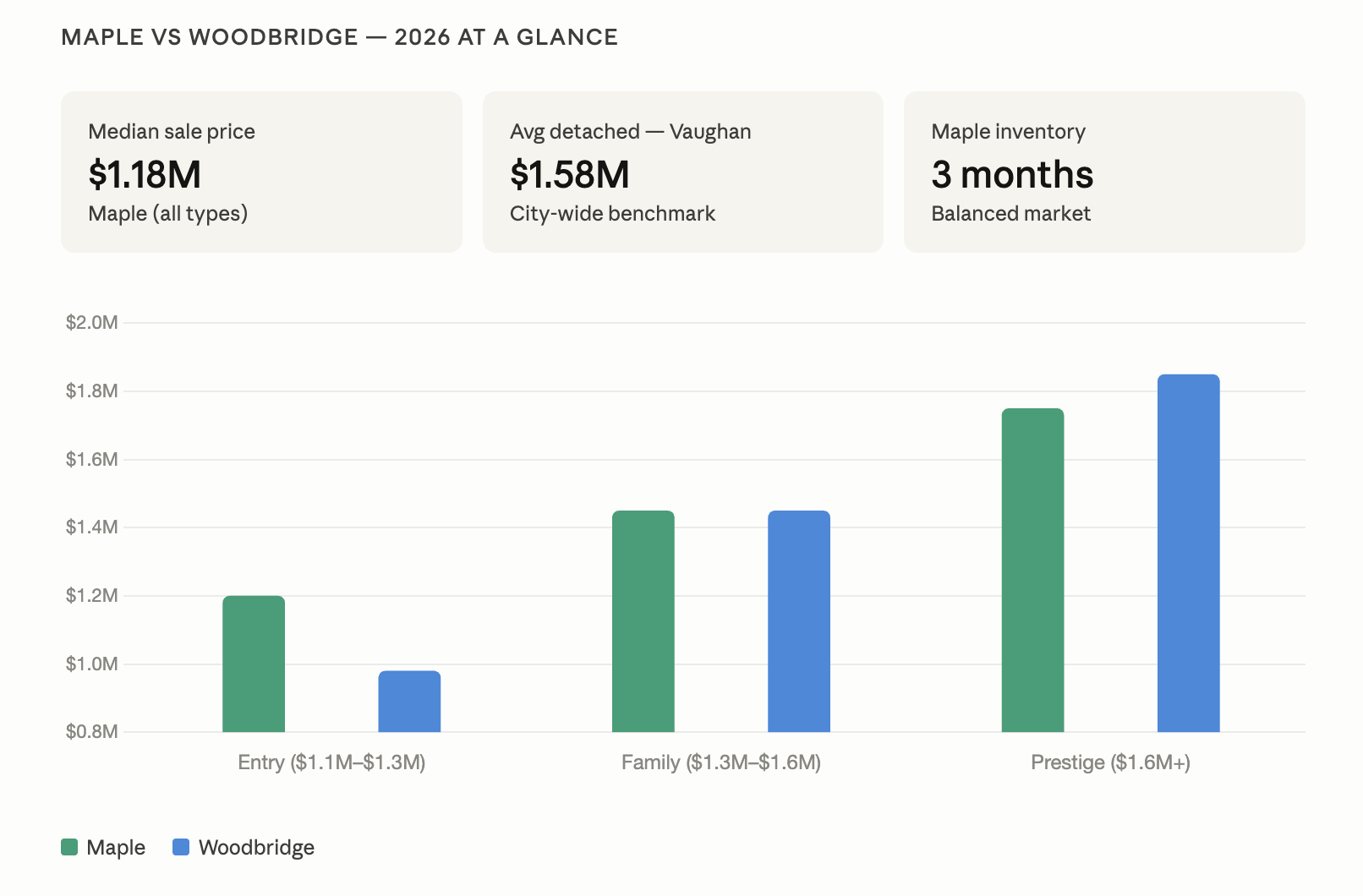
Maple's overall average home price sits at approximately $1,097,730, with a median sales price of $1,180,000. At first glance, that looks affordable relative to broader Vaughan — and it is, but with context. Maple carries a significant condo inventory: 24% of all sales are condominiums. That mix pulls the headline average down. When you isolate detached homes — which is what most family buyers are actually shopping for — you're looking at a different number.
Vaughan's average detached price across the city is running at approximately $1,577,170. Woodbridge detached homes, depending on the pocket, sit in the $1.3M–$1.6M range, with Islington Woods and prestige West Woodbridge streets pushing higher. Maple detached homes in established areas like Rutherford Village and Maple Highlands typically fall in the $1.3M–$1.7M range.
The honest conclusion: at the detached level, these two communities are not dramatically different in price. Buyers expecting Maple to be significantly cheaper than Woodbridge are often surprised. The real differentiator isn't what you pay — it's what you get for that money and how you live day to day.
The Transit Argument: This Is Where Maple Wins Outright
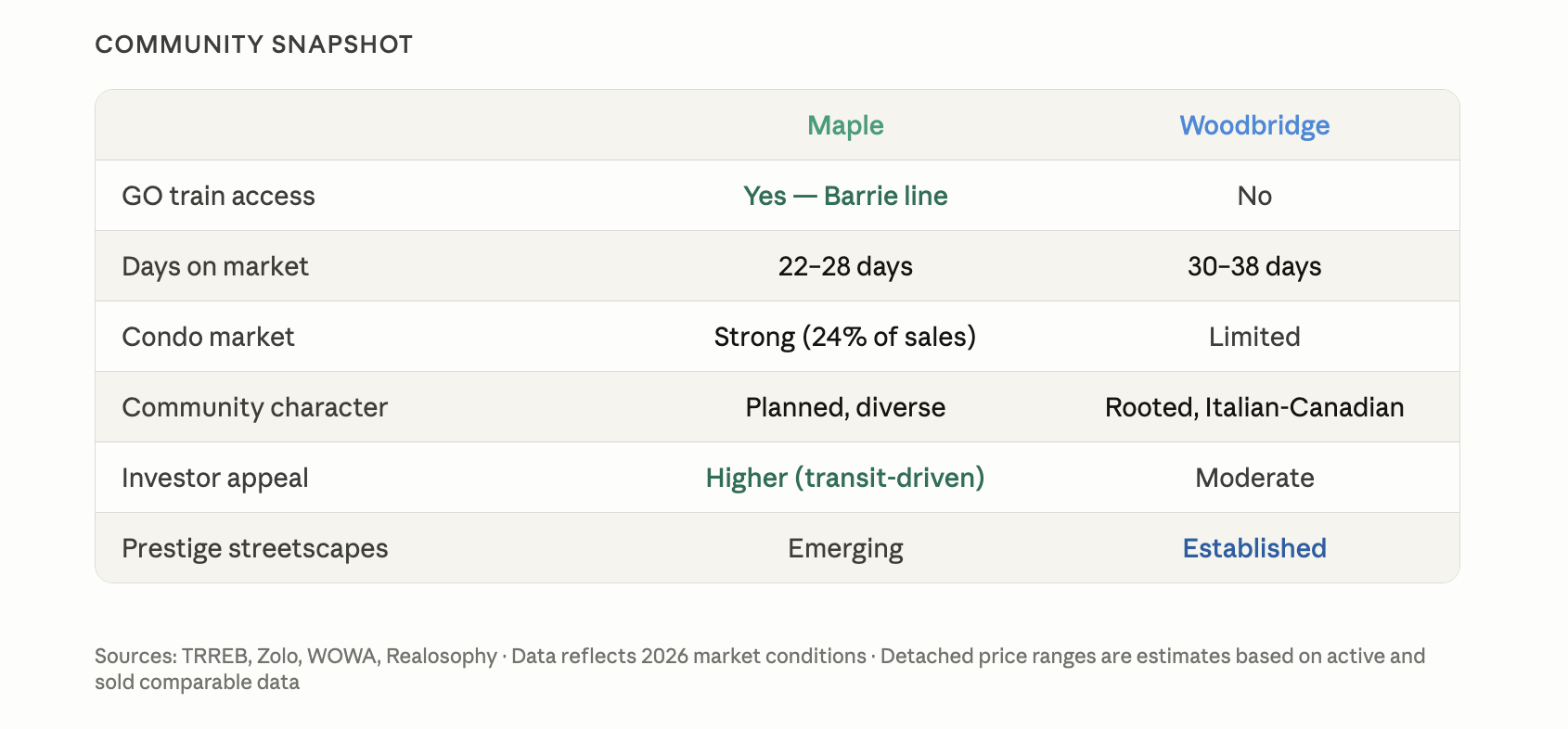
Maple has a GO Station on the Barrie line with service to Union Station. Woodbridge does not.
That's not a minor footnote. For any household where one person commutes into Toronto by transit, this changes the entire lifestyle equation. A buyer in Maple can realistically leave a detached home, walk or drive a few minutes to Maple GO, and be at Union Station without touching the Gardiner. A buyer in Woodbridge cannot replicate that without driving to another community's GO station first.
Over a year of commuting, that difference compounds significantly — in time, in cost, and in daily stress. If transit access is anywhere on your priority list, Maple is the answer. This is not a close call.
For buyers who work entirely from home, or who drive to their destination regardless, this advantage evaporates. Highway 400 serves Maple well; Highway 400 and 427 serve Woodbridge equally well. If you're not using the GO, the transit edge disappears.
Community Character: What Daily Life Actually Feels Like
Woodbridge has a genuine village-within-a-city quality that is difficult to quantify but impossible to miss. The Italian-Canadian community identity is real — not a marketing tagline. Long-term residents know their neighbours. The food scene along Woodbridge Avenue is legitimately excellent. Events like the Woodbridge Fair have roots going back over 150 years. There's a social fabric here that takes decades to build and can't be recreated in a new subdivision.
Maple is newer, more diverse, and more amenity-driven. Rutherford Road has the retail corridor that Woodbridge lacks — big-box convenience, restaurants, services. The community skews toward young families and professionals. Neighbours are friendly, the parks are well-maintained, and the community centres are active. But it has the feel of a planned community, because it largely is one. That's not inherently negative — it's just different.
If you want roots and character, Woodbridge wins. If you want clean infrastructure and convenience, Maple delivers.
Schools: A Genuine Draw in Both Communities
Both Maple and Woodbridge fall within the York Region District School Board and York Catholic District School Board catchments, and both communities have strong options.
Maple families frequently cite Emily Carr Public School, St. Raphael Catholic Elementary, and Maple High School as positives. Woodbridge families point to Father Bressani Catholic High School and a strong network of Catholic elementary schools as particular strengths.
The honest reality: school quality in both communities is above average relative to the broader GTA. If you have a specific school in mind, verify the catchment boundary before you make an offer — it can shift by a few streets and the difference matters. We've seen buyers lose access to their target school because they didn't check this at the address level before committing.
What Does Your Budget Actually Buy? Three Price Points
At $1.1M–$1.3M: In Maple, this range gets you a solid 3-bedroom detached in an established pocket, possibly with a finished basement, on a standard lot. In Woodbridge, the same budget lands you in the semi-detached market or smaller detached homes in the eastern corridor. Maple has more options at this entry level.
At $1.3M–$1.6M: This is the core family home range in both communities. In Maple, you're looking at 4-bedroom detached homes in Rutherford Village or Maple Highlands with newer mechanicals and good lot sizes. In Woodbridge, you start accessing the more established streets in West Woodbridge and the edges of Islington Woods. Both markets are competitive here.
At $1.6M+: Woodbridge starts to differentiate. Islington Woods and prestige West Woodbridge streets offer larger lots, mature trees, and the kind of home that holds its emotional value for decades. Maple at this price point offers newer luxury builds, but the neighbourhood character doesn't yet match what Woodbridge delivers at the same number.
Resale and Long-Term Value: Which Community Holds Better?
Both communities have demonstrated resilience through market cycles, but Woodbridge carries an advantage that's hard to fully capture in data: emotional demand. Families who grew up there want to raise their own children there. That kind of cultural attachment creates a buyer pool that persists through soft markets in a way that purely practical communities can't always replicate.
Maple has strong fundamentals — GO train proximity supports rental demand and resale appeal for a broad buyer profile. As transit-oriented communities continue to outperform in the GTA long term, Maple's position near the Barrie line is an asset that should appreciate in relevance. In a market where commute quality increasingly drives decisions, that matters.
Our read: Woodbridge holds value through emotional demand. Maple holds value through functional demand. Both are durable. Neither is a risky choice.
Who Actually Belongs in Each Community
Buy in Maple if:
- One or both of you commutes into Toronto by transit
- You're prioritizing newer construction and updated mechanicals
- Your budget is in the $1.1M–$1.4M detached range and you want the most home for that money
- You're an investor: the GO train makes Maple rental demand more consistent
- You want retail convenience built around you
Buy in Woodbridge if:
- The community feel and Italian-Canadian character resonate with how you want to live
- You're at $1.5M+ and want a neighbourhood with established prestige and mature streetscapes
- You value roots — long-term neighbours, community events, a sense of place
- Transit doesn't factor into your daily life
- You want the emotional return alongside the financial one
FAQ
Is Maple cheaper than Woodbridge?
At the headline level, Maple's average home price is lower — but that's largely because Maple has a significant condo market that pulls the overall number down. Detached home prices in both communities are closer than most buyers expect, typically both falling in the $1.3M–$1.7M range for comparable family homes. The better question is what you get for the money, not just the number.
Does Maple have better transit than Woodbridge?
Yes, unambiguously. Maple has a GO Station on the Barrie line with direct service to Union Station. Woodbridge has no GO station. For transit-dependent households, this is the single most important differentiator between the two communities.
Which community is better for families?
Both are genuinely good family communities with strong schools, parks, and family-oriented infrastructure. Woodbridge offers deeper community roots and cultural character; Maple offers newer infrastructure and GO train access. Families where school catchment is the primary driver should research specific addresses in both communities before deciding.
Which community has appreciated more over time?
Woodbridge has historically demonstrated strong emotional demand that supports pricing through soft markets. Maple has strong transit-oriented fundamentals that position it well as commute quality becomes an increasingly important factor. Both have delivered solid long-term appreciation — neither has been a consistent underperformer.
Can you live in Maple and commute to Woodbridge, or vice versa?
Easily. They're both within Vaughan and the drive between them is 15–20 minutes depending on traffic. Some buyers choose Maple for the transit and Woodbridge for weekend dining. Living in one doesn't lock you out of the other.
Is Maple a good investment community?
Yes, particularly for rental demand. GO train proximity creates a tenant profile that extends beyond the family buyer market — young professionals, downtown workers who can't yet afford ownership, and corporate renters are all Maple tenants. The fundamentals for investors are stronger in Maple than in Woodbridge for this reason.
The Bottom Line
Maple and Woodbridge are both excellent communities. We've helped clients find great homes and great outcomes in both. But they are not interchangeable — and the buyers who struggle most are the ones who treat them as the same decision at different addresses.
If you're weighing both and want a straight answer from people who've transacted in both communities for over 20 years, reach out. We'll tell you exactly which one fits your situation — without a sales pitch.