
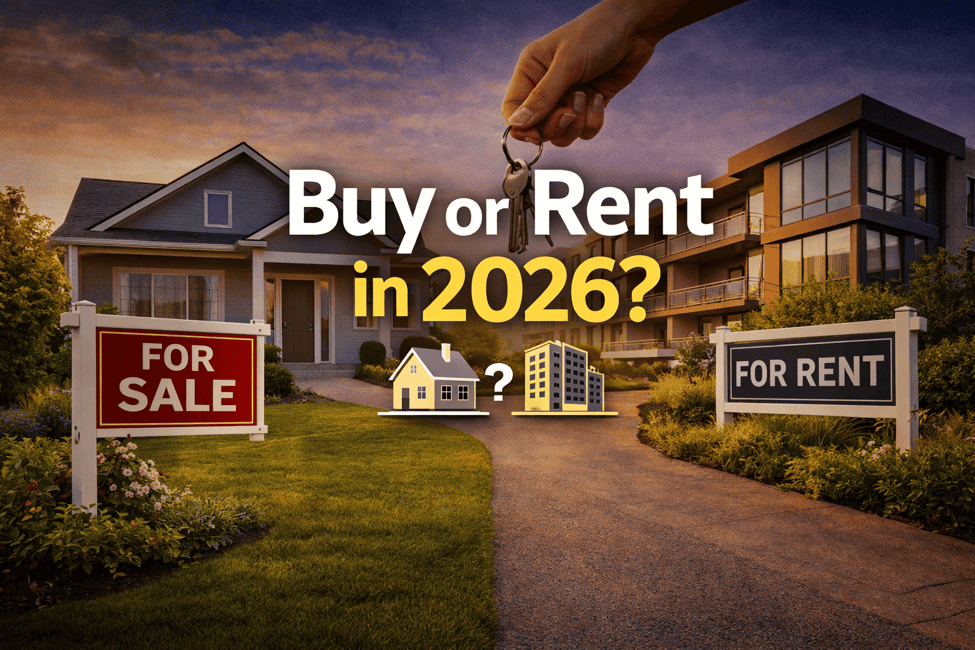
What Actually Makes Sense Right Now?
Buying isn’t automatically wealth. Renting isn’t automatically waste. In 2026, the smarter move depends on how you play the game.
For years, the advice in Canada felt almost automatic:
“Renting is throwing money away.”
“Buying builds wealth.”
“If you don’t own, you’re falling behind.”
That was the playbook. No questions asked.
But here’s the thing… this isn’t 2021 anymore.
The market has shifted. The rules have changed. And blindly following that old advice in 2026? It might quietly cost you six figures!
So instead of opinions, let’s break this down like adults who like their money to stick around.
📺 Watch Full Video
The Market Right Now (And Why It’s Weird)
We’re in one of those rare moments where both home prices and rents are soft at the same time.
That doesn’t usually happen.
Typically:
- If home prices drop → rents go up
- If rents drop → home prices climb
But right now? Both are… taking a breather.
Which sounds nice on the surface, but it actually makes decision-making a lot trickier.
Because if you’re only looking at monthly payments, you might be missing the bigger picture entirely.
The Real Metric: What Money Is Actually Gone Forever?
Let’s simplify this.
Every month, money leaves your bank account. Some of it builds your future. Some of it… disappears into the void.
That disappearing money is what we call unrecoverable cost.
Renting:
You pay your rent. You live your life. Done.
Example: ~$2,150/month → all unrecoverable.
Owning:
Now it gets spicy.
Your mortgage payment isn’t all building equity—especially early on.
- Interest: ~$2,500/month
- Property tax: ~$400/month
- Maintenance: ~$400/month
That’s about $3,300/month in unrecoverable costs.
Yes… more than renting.
So at first glance, renting wins. Easy, right?
Not so fast.
The Entry Cost Nobody Loves Talking About
Buying a home isn’t just about affording the monthly payment.
It’s about getting in the door.
Between land transfer tax, legal fees, and closing costs, you’re looking at:
- ~$35,000 in Toronto
- ~$20,000 outside the city
That money doesn’t grow. It doesn’t invest. It’s just… gone.
And if you sell in a few years? You may not recover it.
Which is why that classic rule still matters:
If you’re not staying at least 5 years, renting often makes more sense.
The Opportunity Cost (The Silent Wealth Builder)
Here’s where things get interesting.
Let’s say instead of buying, you invest your down payment and upfront costs.
Call it roughly $200K+.
At a reasonable long-term return (around 6–7%), that’s potentially:
💰 ~$1,200+ per month in growth
Now renting doesn’t look like “throwing money away”… it looks like flexibility and liquidity.
But wait—this is where real estate punches back.
Leverage: The Secret Weapon (and Risk)
When you invest in stocks, it’s your money doing the work.
When you buy real estate?
The bank is your business partner.
You control a ~$900K asset with ~20% down.
So if the market goes up 7%?
That’s over $60K in value… on your asset.
That’s the power of leverage.
But—and this matters—it works both ways.
If prices drop, that loss hits just as hard.
The Part Spreadsheets Ignore: You
Let’s be honest for a second.
If you had an extra $1,000–$1,500 every month from renting…
Would you invest it consistently?
Or would life… happen?
Trips. Upgrades. Eating out. “I deserve this” moments.
No judgment—it’s human nature.
That’s why:
- Owning forces discipline
- Renting requires discipline
The better option depends on your habits, not just the math.
The “Sleep Factor” 😴
This one doesn’t show up in spreadsheets—but it matters more than people admit.
Renting comes with uncertainty:
- Landlord sells
- You get notice
- You’re forced to move
And if you’ve built a life in that area? That’s stressful.
Owning, on the other hand, brings stability:
- You stay as long as you pay
- You customize your space
- You build roots
That peace of mind? It has real value.
So… What’s the Right Move?
There’s no universal answer—but there is a right answer for you.
Renting Makes More Sense If:
- You plan to move within 5 years
- You’re disciplined with investing
- You value flexibility
Buying Makes More Sense If:
- You’re staying long-term (7–10+ years)
- You want stability and control
- You’re comfortable riding market cycles
And If You’re Trying to Time the Market?
Take a step back.
This isn’t a short-term game anymore.
Real estate in 2026 is about strategy—not speculation.
Final Thoughts
Buying isn’t automatically wealth.
Renting isn’t automatically waste.
Both can work. Both can fail.
It all comes down to:
👉 Your timeline
👉 Your discipline
👉 Your lifestyle
The smartest move? Understanding the full picture before jumping in.
Because today, this decision isn’t emotional anymore.
It’s mathematical.
Ready to Run Your Numbers?
If you’re trying to figure out what actually makes sense for your situation (not your neighbor’s, not TikTok’s, not your cousin’s), let’s break it down together.
No pressure. No sales pitch. Just clarity.
Let’s make sure your next move is the right one 👍