

Every family we work with eventually asks some version of this question: Vellore Village or Maple? Both sit firmly in Vaughan's family-buyer sweet spot. Both have decent price points relative to the rest of the GTA. And on a listing sheet, they can look interchangeable — similar detached inventory, similar drive time to Vaughan Mills, similar “great for families” marketing language that every agent uses for every neighbourhood, whether it's true or not.
It isn't interchangeable. Here's the direct answer: if transit access for a commuting parent is non-negotiable, Maple wins — full stop, it has a GO station and Vellore Village doesn't. If community consistency and newer construction matter more than transit, Vellore Village wins. Below is why, and where the real trade-offs actually live.
Price — What the Family Budget Actually Gets
Vellore Village runs meaningfully higher than Maple across almost every property type. Detached homes in Vellore Village realistically run $1.3M to $1.9M depending on size, condition, and street, versus roughly $1.1M to $1.6M+ for comparable Maple detached product. The gap widens further down the ladder: Maple townhomes run $800,000 to $1,050,000 against Vellore Village's $1.1M to $1.4M, and Maple condos start around $600,000 compared to roughly $712,000 in Vellore Village.
That's not a rounding error. Maple's broader mix of housing types — including a meaningful condo and townhome stock tied to the GO station — genuinely pulls its average down and gives budget-conscious families more entry points into the same general area. Vellore Village's newer, more uniform construction is what buyers are paying the premium for.
If your household is stretching to hit detached ownership, Maple gets you there for meaningfully less. If newer construction and consistent build quality across the neighbourhood matter enough to justify the premium, Vellore Village earns it.
Transit — The One Real Differentiator
This is the piece that actually separates these two communities, more than any other factor. Maple has a GO station on the Barrie line, with direct service to Union Station in roughly 40–50 minutes. Vellore Village does not — the Vaughan Metropolitan Centre subway is technically reachable, but it requires driving or busing to the station from most Vellore Village addresses, so it's a supplementary option, not a real commute solution. For a family with one parent commuting downtown regularly, that's not a nice-to-have — it's the difference between a manageable weekday routine and a genuinely hard one.
Vellore Village families are car-dependent by design. That's fine if both parents work locally or hybrid, and it becomes a real friction point if one parent is doing a daily downtown commute without a transit backup.
Schools — Catchment Reality on Both Sides
Both communities take school catchments seriously, and in both, buying on the wrong side of a boundary line is one of the most common — and most expensive — mistakes we see. Vellore Village's newer subdivisions were largely built around school planning from the start, with several schools genuinely walkable from many addresses, which gives it a slightly more consistent catchment experience street to street. Maple's school situation is more variable because the community itself is a mix of 1980s/90s stock and newer infill — worth verifying school assignment on the specific street before you get attached to a house, not after.
Community Character — Consistent Energy vs. Broader Mix
Vellore Village reads as more uniformly family-oriented, street after street. The demographic is consistent — young and growing families, similar life stage, a genuine sense of shared experience that shows up at the local parks on a Saturday morning.
Maple's demographic is broader. Families, yes, but also investors drawn to the GO station's rental demand, singles and couples in the condo stock near the station, and a wider age range overall in the established sections. Some families like that mix — it feels less homogeneous, more like a real town. Others specifically want the consistency Vellore Village offers. Neither is right or wrong; it's a genuine preference question.
Lifestyle, Parks, and Shopping
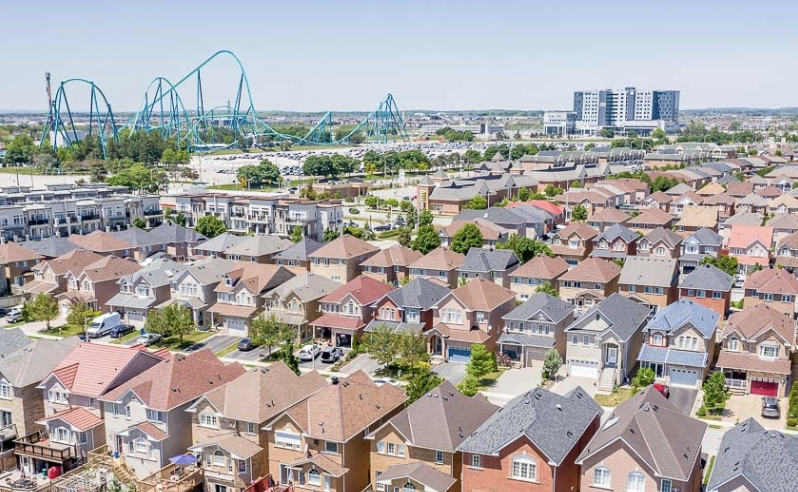
Vellore Village has strong local park and recreation infrastructure built into its newer subdivisions, plus proximity to Cortellucci Vaughan Hospital — a practical consideration more families should weigh than they do. Maple has its own advantages: Canada's Wonderland sits at the edge of the community as a genuine lifestyle amenity for families with younger kids, the Maple Community Centre offers arena, pool, and program space, and the GO station area has been developing more walkable, mixed-use energy over time.
Highway Access and Lot Sizes
Both communities sit reasonably close to Highway 400, so neither has a dramatically better highway position than the other for driving days. Where they differ more is lot configuration: Vellore Village's newer builds tend toward more standardized lot sizes across the community, while Maple's mix of older and newer development means more variability — some genuinely large, mature lots in the established sections alongside newer, tighter subdivisions.
Who Wins for Which Family
Families where one parent commutes downtown by transit: Maple, decisively — the GO station changes the daily math too much to override with anything else.
Families where community consistency and newer construction are the driving factor: Vellore Village, particularly for buyers who want to move in without managing a renovation backlog.
Families prioritizing a consistent, family-life-stage neighbourhood over cultural mix: Vellore Village.
Families on a tighter budget who still want detached ownership: Maple, by a clear margin once you look at actual entry-level pricing across detached, townhome, and condo stock.
My Take After 20 Years Working Both Communities
Neither community is the “better” family neighbourhood in the abstract — that framing is how agents sell you a listing instead of a decision. The real question is which trade-off your household can actually live with day to day: transit access versus newer, more consistent construction; budget flexibility versus paying a premium for uniformity. Answer that honestly first, and the neighbourhood answer follows on its own.
Want to see what's actually available right now instead of just reading about it? Browse current Vellore Village homes for sale or Maple homes for sale.
FAQ
Which is more affordable, Vellore Village or Maple?
Maple, by a real margin across every property type. Comparable detached product runs roughly $200,000 lower than Vellore Village, and Maple has more entry points through condos (from about $600,000) and townhomes (from about $800,000) near the GO station.
Does Vellore Village have GO train access?
No. Maple does, on the Barrie line with a direct run to Union Station in about 40–50 minutes, and it's the single biggest practical difference between the two communities for commuting families.
Which has better schools?
Both take catchments seriously. Vellore Village's newer, uniformly planned subdivisions offer slightly more predictable, walkable catchment experiences; Maple's mix of older and newer development means more street-by-street variability worth checking directly.
Which is better for a family with one parent commuting to downtown Toronto?
Maple, because of the GO station. This is close to a deciding factor on its own for transit-dependent households.
Is Maple only for investors and condo buyers?
No — Maple has substantial family-oriented detached inventory, including larger, mature lots in its established sections. It also happens to attract investor and single-buyer demand near the station, which is why the demographic mix reads broader than Vellore Village's.
What's the biggest mistake families make choosing between them?
Underweighting the transit question. Families who don't currently need a downtown commute sometimes end up needing one within a few years, and Vellore Village doesn't have a transit backup plan if that happens.